
Finale has been more than just notation software to me—it’s been a faithful collaborator, a vault of my creative journey. And I know I’m not alone. For countless composers of my generation—especially those who studied in Brazil—Finale was where our sketches, dreams, and entire musical lives were born.
A petition circulating now—“Release Finale Music Notation Software to the Open-Source Community”—makes it clear how vital Finale and its archives are to many composers. The text highlights a frightening reality: with MakeMusic ending support, “35 years of music, a significant body of works created by musicians around the world, may become inaccessible in the future” (Change.org). It argues compellingly that both final scores and drafts, sketched ideas, and revisions have importance worthy of preservation—especially for future musicologists studying our creative heritage.
Finale’s Formats: Locked In — and Fading Fast
The petition points to a looming threat: after August 2025, MakeMusic will no longer allow activation of Finale on new computers. Combined with inevitable OS updates over the coming years, many of our .mus and .musx files—our legacy—are in peril of becoming unreadable and inaccessible.
Importantly, Finale’s native file formats .mus and .musx are proprietary and cannot be opened by any other software—including Dorico, Sibelius, or MuseScore. These files were explicitly designed to be read only by Finale (MakeMusic).
Nor can Dorico or MuseScore magically open them directly. Dorico cannot import .mus or .musx files. It requires conversion to MusicXML first—and even then, layouts and formatting may need adjustment. Likewise, importing into MuseScore or other notation tools similarly mandates MusicXML as the bridge.
What the Petition Highlights—and the Risk It Presents
Despite the urgency, the petition has generated no tangible results so far: no release to open source, no extended legacy support—just warm words. Meanwhile, the clock is ticking.
If, for example, a future Windows or macOS update breaks compatibility with Finale, stubborn .musx files could become unusable—and lost forever.
What You Can Do—and Should Do—to Preserve Your Work
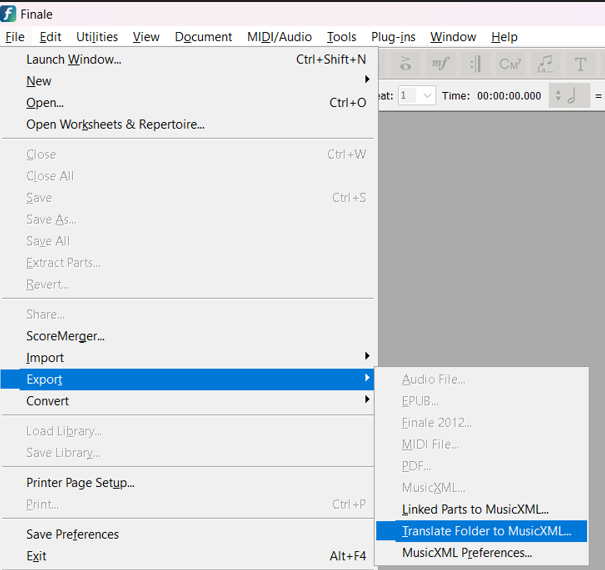
- Convert your Finale archives to MusicXML now, while you still can.
In Finale, go to: File → Export → Translate Folder to MusicXML. This powerful feature lets you batch-convert all Finale files in a folder—though subfolders won’t be included, so be sure to run it on each folder individually. - Also export PDFs, if you haven’t done this yet, just in case the conversion misses special annotations and images.
- Save everything with backups.
- Even if you believe your PDFs “protect” your scores, MusicXML offers far more future compatibility. It can be reinterpreted by modern notation programs—used with playback plugins or future editing tools. If you want to revise your piece, or if you don’t have the parts of an orchestral piece, you will need at least the MusicXML file.
- Archive your drafts and ideas, too. These are treasures for future scholars and your own creative ecosystem.
Let’s ensure our voices are preserved and future-proof!
Why This Matters
- Legacy kept alive: MusicXML files ensure scores—and even creative drafts—remain usable, portable, and interpretable.
- Technological safety net: PDFs alone don’t guarantee long-term playback or editing. MusicXML ensures continued relevance.
- Future scholarship: Musicologists, educators, and even AI tools could one day analyse, teach, and breathe new life into your archived work.
- Responsibility now: After Finale fades altogether, it may be too late. Even with AI it might be really hard to rescue original .mus or .musx files in future (I did some research on this).
What to use now?
I’ve begun exploring Dorico and MuseScore. I also use Sibelius sometimes, when I have some academic work that needs editing.
MuseScore is good for quick tasks, but it’s still not great for writing contemporary music, and I don’t like its note entry scheme. It preserves rests unless you explicitly remove time, and this is very annoying to me. Other things that bother me: you can’t copy mixed timed signatures, for example, a bar 4/4 and the next is 3/8, if this pattern repeats, you have to write it manually for every bar. It also doesn’t fully recover Finale’s layout when converting MusicXML files; it gets the essentials back, but several other things can become pretty messy. The advantage is that it’s free, so as I said, for quick tasks, it’s a good choice.
Regarding Dorico, I’m still exploring it and trying to get used to it. I’m unsure what to recommend now for Finale users; all workflows of other notation software are different and take time to get used to. If you have a suggestion, please leave a comment!